Jade Plant: what your moisture meter reading means
The healthy band for a jade plant, on whichever scale your meter prints — and, more usefully, what the same number means in different situations.
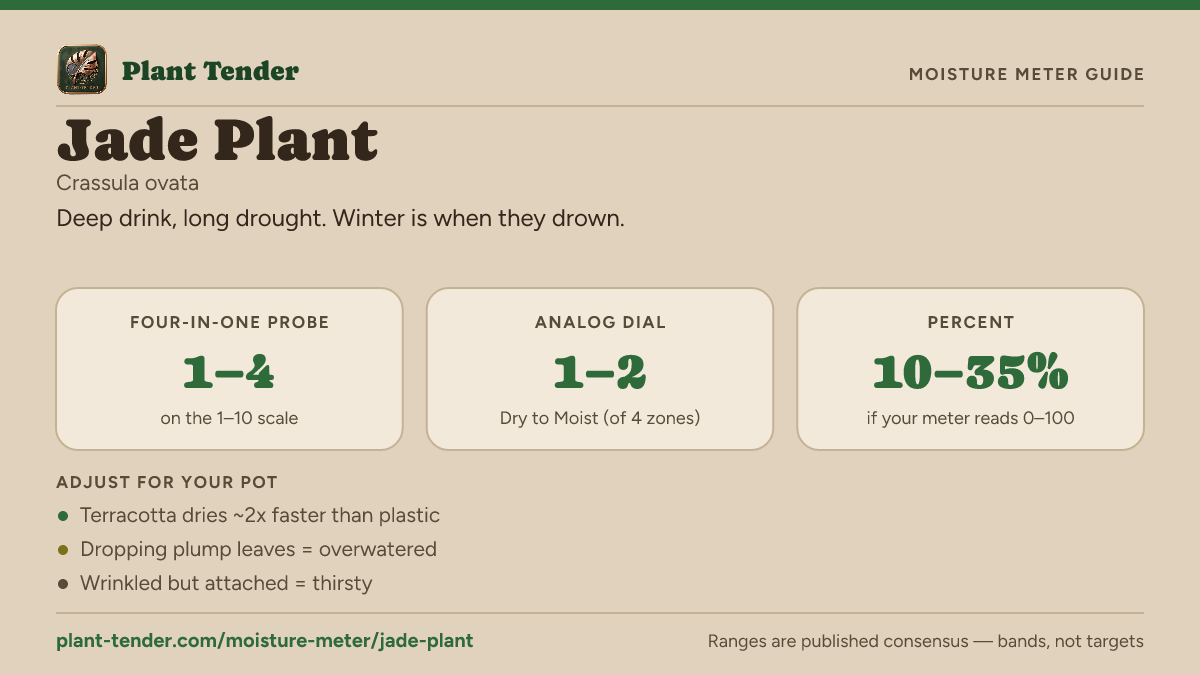
Percent (0–100)
10–35%
what the four-in-one we recommend prints
Ten-point probe (1–10)
1–4
if your probe prints a bare 1–10 sweep
Analog dial
1–2
Dry to Moist — of 4 zones
That is the band you are aiming for, not a target to hit exactly. These ranges are published horticultural consensus and are deliberately banded wide — these are unpowered galvanic probes, two of them in the same pot routinely disagree, and fertilizer salt raises the reading with no extra water present.
Got the plant in front of you? Point your camera at it — Plant Tender names what is in the pot from one photo and gives you the numbers it wants. No account, no card.
What each reading means for a jade plant
A jade plant wants water below 10% and starts staying wetter than it likes above 35%. If your probe prints a bare 1–10 sweep instead of a percentage, that works out like this.
| Reading | For this plant | What to do |
|---|---|---|
| 1 | In the healthy band | Inside the healthy band. Leave it — the useful question is whether this number is falling since last time. |
| 2 | In the healthy band | Inside the healthy band. Leave it — the useful question is whether this number is falling since last time. |
| 3 | In the healthy band | Inside the healthy band. Leave it — the useful question is whether this number is falling since last time. |
| 4 | Wetter than ideal | Wetter than ideal. Fine a day or two after watering; a concern if it has been a week. |
| 5 | Wetter than ideal | Wetter than ideal. Fine a day or two after watering; a concern if it has been a week. |
| 6 | Wetter than ideal | Wetter than ideal. Fine a day or two after watering; a concern if it has been a week. |
| 7 | Saturated | Saturated. If this has not fallen in several days, check drainage before you change anything else. |
| 8 | Saturated | Saturated. If this has not fallen in several days, check drainage before you change anything else. |
| 9 | Saturated | Saturated. If this has not fallen in several days, check drainage before you change anything else. |
| 10 | Saturated | Saturated. If this has not fallen in several days, check drainage before you change anything else. |
Every row here is worked out from this plant's own numbers — a jade plant at 4 and a snake plant at 4 are in genuinely different situations.
The number depends on your soil, and most charts ignore that
A jade plant is usually in gritty succulent mix in a heavy pot — jades get top-heavy and need the ballast.
Like other succulents, jade is usually in a mix that reads low regardless of water content, so absolute numbers mean less than the direction of travel. Jade is also commonly grown in terracotta, which pulls moisture out through the pot wall and shortens the drying cycle substantially compared to the same mix in plastic — often by half.
Adjusting for your mix
Gritty mix in terracotta: readings run low and fall fast; a week from wet to bottom-of-scale is normal in summer. Gritty mix in glazed or plastic: the same reading takes two to three weeks to fall, and that difference is where winter overwatering happens. Nursery potting soil: repot. A jade in dense soil is on a countdown.
Plant Tender asks which of these your pot is in — dense potting soil, chunky aroid mix, bark / orchid mix, semi-hydro / pon, succulent / cactus grit — and applies the adjustment for you, along with a probe-depth target from your pot size.
Where to put the probe
Deep, at the pot wall, away from the thick surface roots. Jade root systems are surprisingly shallow relative to the size of the plant, so the deep reading is about water the plant may never reach — take both a mid and a deep reading and pay attention to the mid one, using the deep one to confirm the pot is actually draining.
How a jade plant actually fails
Leaf drop after overwatering, which is counterintuitive enough that people respond by watering more. An overwatered jade drops leaves that are still plump and look healthy — they simply detach. A thirsty jade wrinkles its leaves and holds onto them. Stem rot follows, starting as a soft dark section low on the trunk, and by that point the plant usually has to be restarted from a cutting. In winter, when growth stops, the drinking rate falls sharply and an unchanged watering habit becomes overwatering with no other change.
Common situations
My jade is dropping plump, healthy-looking leaves.
That is the overwatering signature, and it is the opposite of what it looks like. A thirsty jade wrinkles and holds on; an overwatered one drops leaves that still look perfect. Stop watering, let the pot go to the bottom of the scale and stay there for several days, and check the trunk low down for any soft section. If the trunk is firm the plant will recover; if it is soft, take a healthy cutting now while you still can.
Should I water my jade less in winter?
Substantially less, and this is where most jades are lost. Growth stops in low winter light, water uptake drops with it, and a pot that dried in a week in July can take a month in January. Nothing about the plant looks different — which is why the meter matters here: the number simply stops falling, and that stall is the signal to stretch the interval.
The meter reads 4 and the leaves are wrinkled.
Wrinkled leaves mean the plant is drawing on stored water, so give it a thorough soak — water until it runs from the drainage hole rather than a small top-up, which never reaches the deeper roots. If the wrinkling does not resolve within a week of a proper soak at a falling reading, the roots are damaged and the pot needs to come apart for a look.
One reading can't be trusted. How fast the pot dries out can.
Everything above is really one argument: a single number from a cheap conductivity probe is not a measurement, it is a data point with a large error bar. Fertilizer salt raises it. Air gaps in chunky mix lower it. Probe depth moves it several points. Two meters in the same pot disagree.
What survives all of that is the trend. The same meter, in the same spot, in the same pot, read over a few weeks, tells you how fast your jade plant in this specific mix in this specific room actually dries — and that is the thing that answers "do I water it", which no chart can do for you.
Stop looking it up. Point your camera at your jade plant.
The bands above are for jade plant in general. Plant Tender gets there from a photo instead: one shot of what is actually in the pot, and it names the plant and gives you the soil-moisture, soil-temperature and light numbers that plant wants. Your first scan needs no account and no card.
Scan a plant — free, no accountAlready know what it is? Save it to Plant Tender and it remembers what your jade plant read last time, then tells you water or leave-it-be — so you are reading a trend instead of interpreting one number in isolation. Free for your first three plants.
Ranges come from Plant Tender's per-species dataset, which is version-controlled and reviewed in public — Crassula ovata, 10–35% moisture, 51–80°F soil temperature, bright direct light.