Snake Plant: what your moisture meter reading means
The healthy band for a snake plant, on whichever scale your meter prints — and, more usefully, what the same number means in different situations.
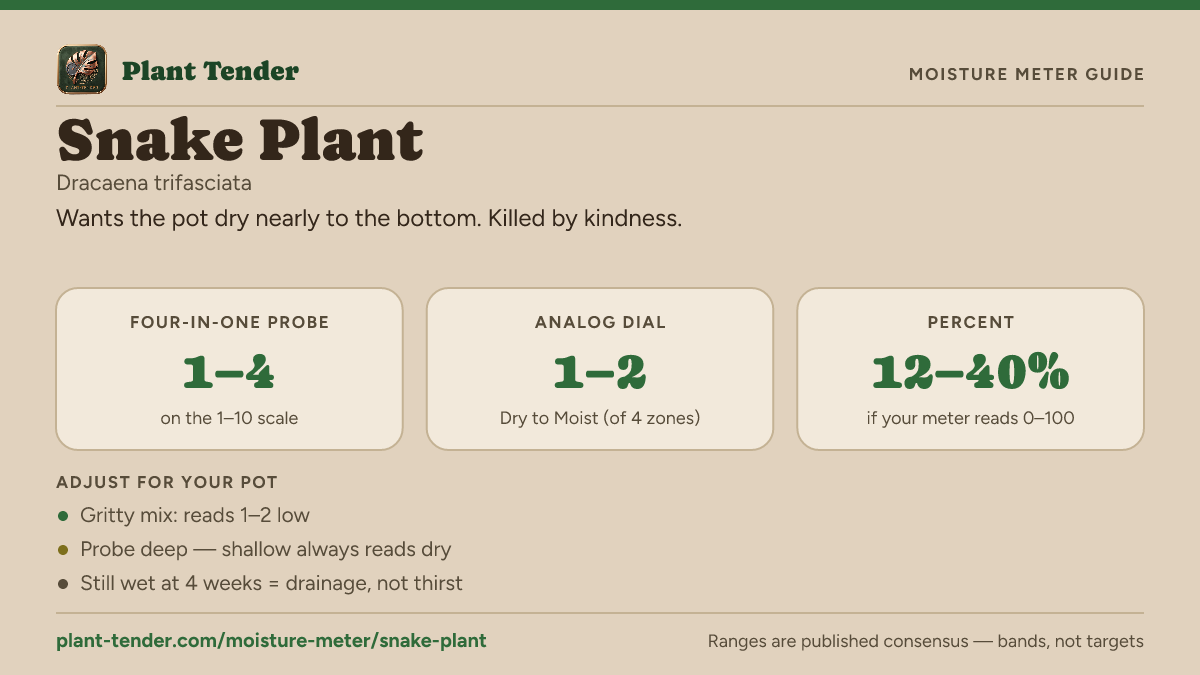
Percent (0–100)
12–40%
what the four-in-one we recommend prints
Ten-point probe (1–10)
1–4
if your probe prints a bare 1–10 sweep
Analog dial
1–2
Dry to Moist — of 4 zones
That is the band you are aiming for, not a target to hit exactly. These ranges are published horticultural consensus and are deliberately banded wide — these are unpowered galvanic probes, two of them in the same pot routinely disagree, and fertilizer salt raises the reading with no extra water present.
Got the plant in front of you? Point your camera at it — Plant Tender names what is in the pot from one photo and gives you the numbers it wants. No account, no card.
What each reading means for a snake plant
A snake plant wants water below 12% and starts staying wetter than it likes above 40%. If your probe prints a bare 1–10 sweep instead of a percentage, that works out like this.
| Reading | For this plant | What to do |
|---|---|---|
| 1 | Thirsty | Dry enough to water. Water on the next check unless you watered in the last day or two. |
| 2 | In the healthy band | Inside the healthy band. Leave it — the useful question is whether this number is falling since last time. |
| 3 | In the healthy band | Inside the healthy band. Leave it — the useful question is whether this number is falling since last time. |
| 4 | In the healthy band | Inside the healthy band. Leave it — the useful question is whether this number is falling since last time. |
| 5 | Wetter than ideal | Wetter than ideal. Fine a day or two after watering; a concern if it has been a week. |
| 6 | Wetter than ideal | Wetter than ideal. Fine a day or two after watering; a concern if it has been a week. |
| 7 | Wetter than ideal | Wetter than ideal. Fine a day or two after watering; a concern if it has been a week. |
| 8 | Saturated | Saturated. If this has not fallen in several days, check drainage before you change anything else. |
| 9 | Saturated | Saturated. If this has not fallen in several days, check drainage before you change anything else. |
| 10 | Saturated | Saturated. If this has not fallen in several days, check drainage before you change anything else. |
Every row here is worked out from this plant's own numbers — a snake plant at 4 and a snake plant at 4 are in genuinely different situations.
The number depends on your soil, and most charts ignore that
A snake plant is usually in gritty, fast-draining cactus or succulent mix — sand and perlite heavy.
Grit mix barely holds water at all, which is the point, and it wrecks probe contact. Sand and perlite do not conduct between the probe pins the way soil does, so a snake plant in proper mix reads low even when there is water present. If you moved a snake plant from nursery soil to a gritty mix and the readings dropped by two points overnight, nothing changed about the water — the medium changed.
Adjusting for your mix
Gritty cactus mix: readings run one to two points LOW; do not chase the number upward by watering. Nursery peat (what it almost certainly came in): readings are honest but the mix holds water far longer than this plant wants — this combination is the leading cause of dead snake plants. Terracotta versus plastic changes the drying time more than the mix does.
Plant Tender asks which of these your pot is in — dense potting soil, chunky aroid mix, bark / orchid mix, semi-hydro / pon, succulent / cactus grit — and applies the adjustment for you, along with a probe-depth target from your pot size.
Where to put the probe
Deep — most of the pot. Snake plant rhizomes sit shallow and the roots run down and out, so a shallow reading tells you about the layer the plant has already finished with. Insert at the pot edge, away from the rhizome mass, and go as deep as the probe allows. If you hit something firm and the reading spikes, that is a rhizome; move over.
How a snake plant actually fails
Rot at the base, and it is nearly always fatal by the time it is visible. The tell is a leaf that goes soft and slightly translucent an inch above the soil and pulls away from the rhizome with almost no resistance. A healthy snake plant leaf is rigid to the base. This is the species where the meter earns its keep: the plant gives you no warning at all, so a pot that still reads too wet to water three weeks on is the only signal you will get.
Common situations
My snake plant reads 3 — is that dry enough to water?
Almost, and this is the species where "almost" means wait. A snake plant wants the pot dry nearly to the bottom, and a 3 taken deep in a gritty mix often still means moisture at the root tips. If you took that reading shallow, take another as deep as the probe goes — the deep number is the one that decides. In doubt with this plant, wait another four days. It has cost nobody a snake plant.
My snake plant reads 6 and it has been a month since I watered.
That is a drainage problem, not a watering question, and it is urgent. A month-old pot reading 6 means water is sitting somewhere it cannot leave — no drainage hole, a decorative cachepot with standing water in the bottom, or a mix that has compacted into a plug. Snake plants tolerate drought indefinitely and rot in weeks. Take it out of the pot and look at the roots.
Can I just water a snake plant monthly and ignore the meter?
In a bright window in summer, a monthly schedule is roughly right. In a dim room in winter the same pot can take ten weeks to dry, and a monthly schedule drowns it — which is exactly how the plant with the reputation for being unkillable gets killed. The schedule is not wrong because it is a schedule; it is wrong because the drying rate changes by a factor of three across the year and the schedule does not.
One reading can't be trusted. How fast the pot dries out can.
Everything above is really one argument: a single number from a cheap conductivity probe is not a measurement, it is a data point with a large error bar. Fertilizer salt raises it. Air gaps in chunky mix lower it. Probe depth moves it several points. Two meters in the same pot disagree.
What survives all of that is the trend. The same meter, in the same spot, in the same pot, read over a few weeks, tells you how fast your snake plant in this specific mix in this specific room actually dries — and that is the thing that answers "do I water it", which no chart can do for you.
Stop looking it up. Point your camera at your snake plant.
The bands above are for snake plant in general. Plant Tender gets there from a photo instead: one shot of what is actually in the pot, and it names the plant and gives you the soil-moisture, soil-temperature and light numbers that plant wants. Your first scan needs no account and no card.
Scan a plant — free, no accountAlready know what it is? Save it to Plant Tender and it remembers what your snake plant read last time, then tells you water or leave-it-be — so you are reading a trend instead of interpreting one number in isolation. Free for your first three plants.
Ranges come from Plant Tender's per-species dataset, which is version-controlled and reviewed in public — Dracaena trifasciata, 12–40% moisture, 56–83°F soil temperature, low to bright indirect light.