Philodendron: what your moisture meter reading means
The healthy band for a philodendron, on whichever scale your meter prints — and, more usefully, what the same number means in different situations.
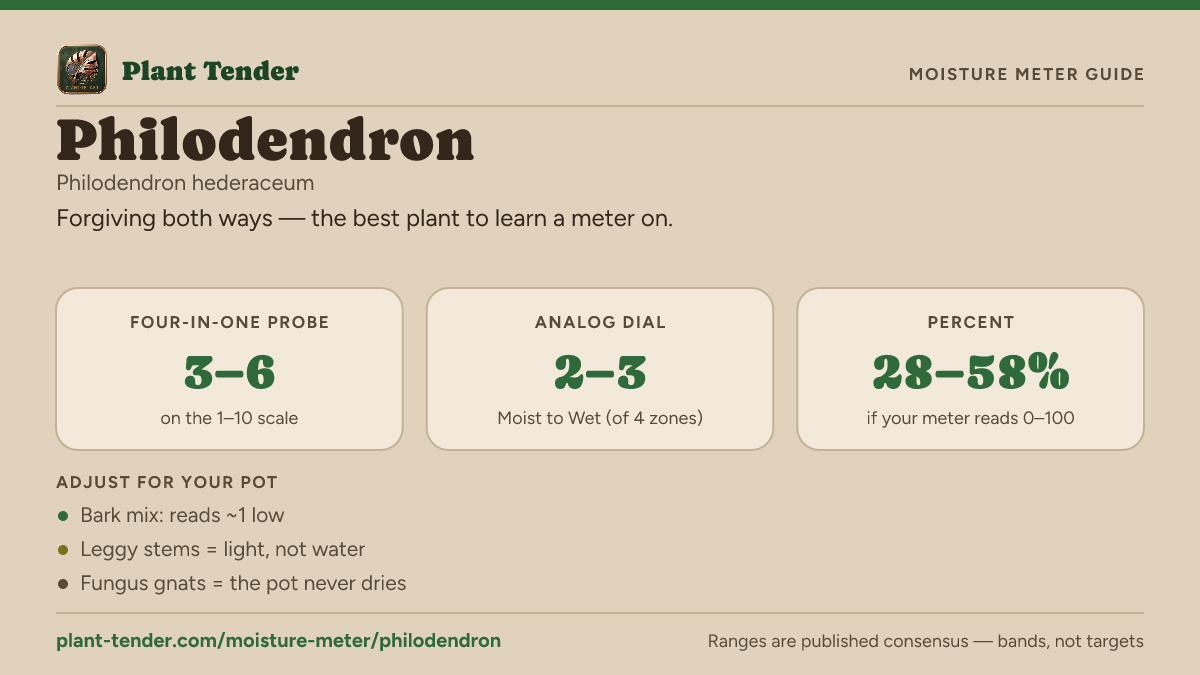
Percent (0–100)
28–58%
what the four-in-one we recommend prints
Ten-point probe (1–10)
3–6
if your probe prints a bare 1–10 sweep
Analog dial
2–3
Moist to Wet — of 4 zones
That is the band you are aiming for, not a target to hit exactly. These ranges are published horticultural consensus and are deliberately banded wide — these are unpowered galvanic probes, two of them in the same pot routinely disagree, and fertilizer salt raises the reading with no extra water present.
Got the plant in front of you? Point your camera at it — Plant Tender names what is in the pot from one photo and gives you the numbers it wants. No account, no card.
What each reading means for a philodendron
A philodendron wants water below 28% and starts staying wetter than it likes above 58%. If your probe prints a bare 1–10 sweep instead of a percentage, that works out like this.
| Reading | For this plant | What to do |
|---|---|---|
| 1 | Bone dry | Well past dry. Water thoroughly now — look for leaves curl inward slightly along the midrib and the newest growth pauses. |
| 2 | Thirsty | Dry enough to water. Water on the next check unless you watered in the last day or two. |
| 3 | In the healthy band | Inside the healthy band. Leave it — the useful question is whether this number is falling since last time. |
| 4 | In the healthy band | Inside the healthy band. Leave it — the useful question is whether this number is falling since last time. |
| 5 | In the healthy band | Inside the healthy band. Leave it — the useful question is whether this number is falling since last time. |
| 6 | Wetter than ideal | Wetter than ideal. Fine a day or two after watering; a concern if it has been a week. |
| 7 | Wetter than ideal | Wetter than ideal. Fine a day or two after watering; a concern if it has been a week. |
| 8 | Saturated | Saturated. If this has not fallen in several days, check drainage before you change anything else. |
| 9 | Saturated | Saturated. If this has not fallen in several days, check drainage before you change anything else. |
| 10 | Saturated | Saturated. If this has not fallen in several days, check drainage before you change anything else. |
Every row here is worked out from this plant's own numbers — a philodendron at 4 and a snake plant at 4 are in genuinely different situations.
The number depends on your soil, and most charts ignore that
A philodendron is usually in loose, bark-amended aroid mix; tolerant of standard potting soil too.
Heartleaf philodendron is genuinely forgiving in both directions, which makes it the best plant on this list to learn a meter on: mistakes are recoverable and the plant shows the response clearly. In loose mix the pot swings quickly and readings are responsive; in dense soil it holds a flatter, higher number for longer.
Adjusting for your mix
Bark-amended aroid mix: readings run about a point low from air gaps, and the pot dries in roughly a week. Dense potting soil: the reading holds high and the plant tolerates it, but that is where the fungus gnats arrive. Hanging baskets dry substantially faster than the same mix on a shelf, because of airflow on all sides.
Plant Tender asks which of these your pot is in — dense potting soil, chunky aroid mix, bark / orchid mix, semi-hydro / pon, succulent / cactus grit — and applies the adjustment for you, along with a probe-depth target from your pot size.
Which philodendron do you have?
Philodendron is a genus of a few hundred species, and nearly everything sold under the name is labelled just "philodendron". The numbers above are the heartleaf, which is what most plain green trailing ones are. Here is where the commonly sold cultivars genuinely differ once a probe goes in the pot — and, just as usefully, where they do not.
Philodendron Brasil
Philodendron hederaceum 'Brasil' — spelled with an s, though most people type Brazil
The same band as a plain heartleaf. What changes is the light it needs, and light is what sets how fast the pot empties.
Brasil is the same species as the plant these numbers were written for — a heartleaf carrying a lime and cream stripe down the middle of each leaf — and it is the same plant whether the label spells it Brasil or Brazil. There is no chlorophyll in that stripe, so a Brasil needs a brighter spot than a plain green one to hold it; in a dim corner the new leaves come in solid green and stay that way. The consequence lands on the pot rather than the plant: a Brasil is usually in the brightest place in the room, very often in a hanging basket, and both of those empty a pot noticeably faster than the shelf a plain heartleaf sits on. Same numbers to aim for, shorter gap between drinks. If yours is losing its stripe, that is the light asking to change — watering more will not bring it back.
Philodendron micans
Philodendron hederaceum var. hederaceum
On a meter, the same plant. What differs is how early it tells you it is thirsty without one.
Micans is the velvet-leaved form of the same heartleaf species, so every number on this page applies to it unchanged. There is no separate micans range, and anyone offering you one is guessing. The real difference is in the leaf: a velvet surface goes flat and slightly papery a day or two before the leaf loses its shape, which is earlier than a glossy heartleaf gives you anything at all. Micans is also sold in small, shallow trailing pots more often than the plain form, and a small pot empties fast whatever is growing in it — so if yours seems to want water far more often than this page suggests, measure the pot before you doubt the numbers.
Philodendron Birkin
a sport of a Philodendron erubescens hybrid — not a heartleaf at all
Near enough on the numbers. Different enough in shape that the probe advice below has to change.
The giveaway is that a Birkin does not trail. It grows upright from one thick, short stem, so instead of the even fibrous mat this page describes you get a dense plug of thicker roots packed directly under the crown. Push a probe in near that crown and you read root rather than soil, and the number comes back high — go out to the halfway point between the stem and the pot wall and stay there. We do not hold a separately reviewed set of numbers for Birkin; the heartleaf range above is a fair guide for it, and the gap between the two is smaller than the gap your potting mix makes. The white pinstripes are unstable, which trips people up: a Birkin throwing plain green leaves is reverting and wants more light, and one throwing near-white leaves cannot feed itself and will lose them. Neither is a water problem, and neither will show up on a meter.
Philodendron Pink Princess
Philodendron erubescens 'Pink Princess'
Same band — and the pinker the plant, the slower its pot empties. That is why this is the philodendron people overwater.
The pink is leaf tissue with no chlorophyll in it. A leaf that is half pink does roughly half the work of a green one, so a heavily marked plant grows slowly, and because growing and drinking go together, it empties its pot slowly too. Put a Pink Princess and a plain philodendron of the same size in the same window in the same mix, and the Pink Princess will still be reading wet when the other one is ready for water. That is the whole failure in one sentence: the plant is expensive, so people pay it close attention, and close attention paid to a pot that is not drying is how this one dies. Read the pot rather than the calendar — and the more pink your particular plant carries, the further apart the drinks go.
Where to put the probe
Mid-depth, halfway between the crown and the wall. Philodendron root systems are fibrous and even, so placement is not fussy. In a wide, shallow hanging pot take the reading on the side away from the window — the sunlit side dries first and reads low while the far side is still wet.
How a philodendron actually fails
Long bare stretches of stem between leaves, which people read as a water problem and treat by watering more. It is a light problem: the plant is stretching. The actual water failure mode is undramatic — stems yellow and go soft at the soil line one at a time, and the plant keeps growing elsewhere, so it can take months to notice. A pot sitting at the top of the range indefinitely is the thing to catch.
Common situations
My philodendron reads 5 — water or wait?
Wait, if it has been under a week since the last drink. Philodendrons prefer the top couple of inches to dry, and 5 mid-depth usually means the top is drying while the core is fine. If it has been over a week and still reads 5, look at drainage and light before you look at watering — a plant in dim light drinks slowly enough that a normal watering cadence becomes overwatering without anything else changing.
The vines are long and leggy with tiny leaves.
That is a light answer, not a water one, and no watering change will fix it. Move it somewhere brighter and cut the leggy vines back — philodendrons branch readily from a cut node and the new growth will come in with proper spacing and full-size leaves. Root the cuttings and put them back in the same pot to thicken it up.
Small flies keep appearing around the pot at a reading of 7.
Fungus gnats, and a persistent 7 is why: they breed in the top layer of permanently damp soil. The fix is the drying cycle, not an insecticide — let the top of the pot dry properly between waterings and the larvae have nowhere to develop. A layer of coarse grit on the surface stops the adults laying while the mix underneath is still adjusting.
One reading can't be trusted. How fast the pot dries out can.
Everything above is really one argument: a single number from a cheap conductivity probe is not a measurement, it is a data point with a large error bar. Fertilizer salt raises it. Air gaps in chunky mix lower it. Probe depth moves it several points. Two meters in the same pot disagree.
What survives all of that is the trend. The same meter, in the same spot, in the same pot, read over a few weeks, tells you how fast your philodendron in this specific mix in this specific room actually dries — and that is the thing that answers "do I water it", which no chart can do for you.
Stop looking it up. Point your camera at your philodendron.
The bands above are for philodendron in general. Plant Tender gets there from a photo instead: one shot of what is actually in the pot, and it names the plant and gives you the soil-moisture, soil-temperature and light numbers that plant wants. Your first scan needs no account and no card.
Scan a plant — free, no accountAlready know what it is? Save it to Plant Tender and it remembers what your philodendron read last time, then tells you water or leave-it-be — so you are reading a trend instead of interpreting one number in isolation. Free for your first three plants.
Ranges come from Plant Tender's per-species dataset, which is version-controlled and reviewed in public — Philodendron hederaceum, 28–58% moisture, 61–78°F soil temperature, low to bright indirect light.